
RV Park Access Control: Managing Guest Entry, Vehicle Flow, and Shared Spaces
An RV park or outdoor resort operates differently from traditional commercial properties. Guests arrive with vehicles, trailers, family members, pets, bicycles, deliveries, and sometimes additional visitors. Staff may need to manage check-ins, late arrivals, maintenance access, amenity use, contractor visits, seasonal guests, and perimeter concerns across a large outdoor property.
That makes access control an important part of RV park operations. The goal is not to make the property feel restrictive. The goal is to create a safer, more organized environment where authorized guests can move easily, staff can manage access with less manual effort, and property owners have better visibility when something needs to be reviewed.
For RV parks, access control works best when it is designed around real guest movement.
Why RV Park Access Control Is Different
A standard office access control system usually focuses on doors. RV parks have a wider range of access points and user types.
An RV park may need to control or monitor:
- Main vehicle gates
- Pedestrian entrances
- Clubhouses and lounges
- Laundry rooms
- Pools and fitness areas
- Washrooms and shower buildings
- Equipment rooms
- Storage areas
- Staff-only buildings
- Cabins or rental units
- Maintenance yards
- Utility rooms
- After-hours entrances
- Contractor and vendor access
Unlike a single building, an RV park may have open boundaries, multiple roads, decentralized amenities, and seasonal traffic patterns. A practical access control plan needs to support that reality.
Start With the Main Entrance
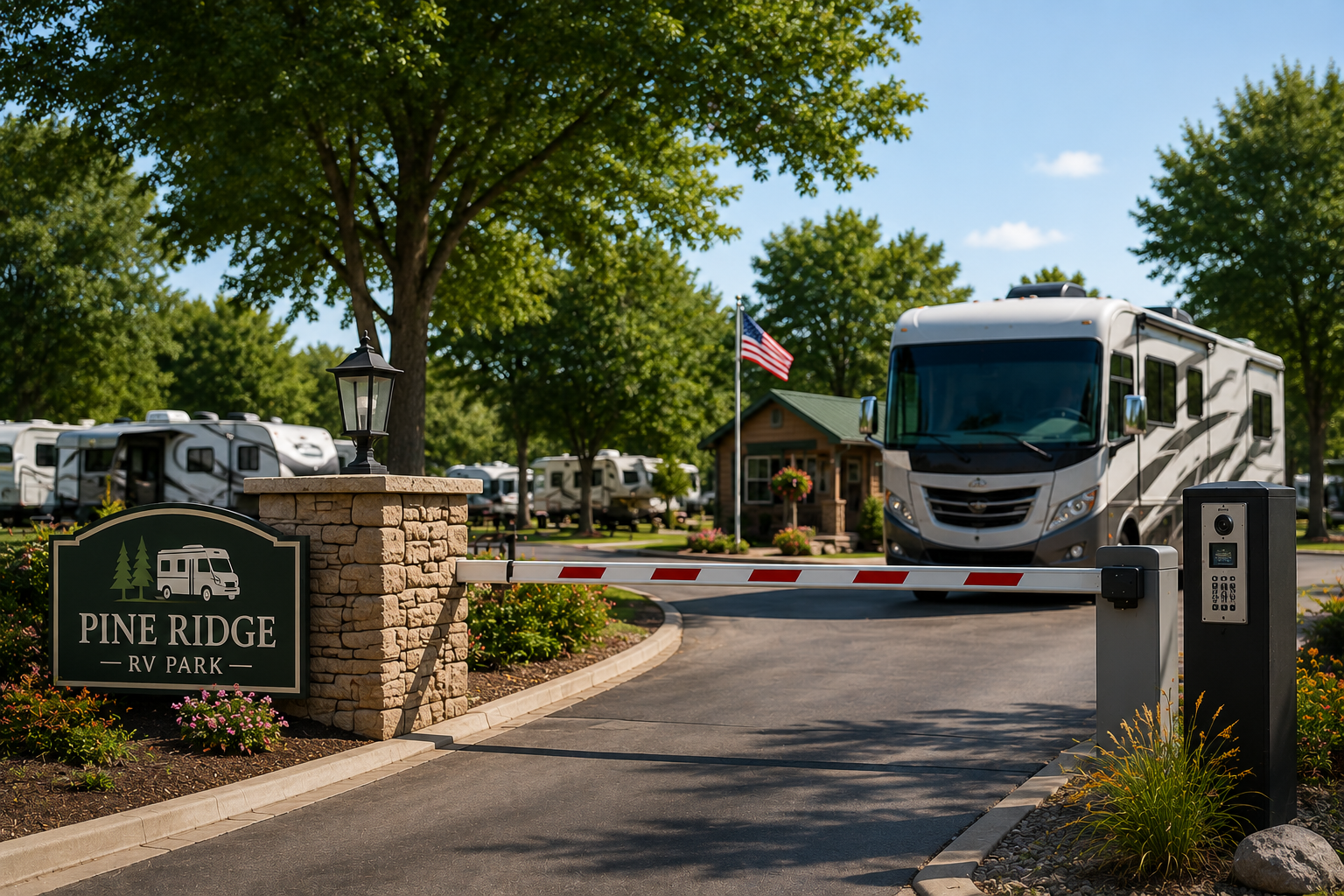
For many RV parks, the main gate is the most important control point. It is where guests arrive, where vehicles are identified, and where staff first confirm whether someone should be on site.
Traditional gate codes can be simple, but they can also be shared, forgotten, reused, or left active after a booking ends. Over time, shared codes can reduce accountability because it becomes harder to know who entered and when.
More structured options may include:
- License plate recognition for registered guest vehicles
- RFID or long-range credentials for seasonal guests
- Mobile credentials or QR codes for temporary access
- Intercom verification for after-hours arrivals
- Time-limited contractor or vendor access
- Access schedules tied to reservation dates
The right method depends on the property, staffing model, guest expectations, and infrastructure.
Vehicle Access and License Plate Recognition
Vehicle flow is central to RV park operations. Guests often arrive with large vehicles, trailers, or tow vehicles, which means access points must be designed for safe, predictable movement.
License plate recognition can help turn the gate into an intelligent checkpoint. Instead of relying only on a code or fob, the system can identify registered vehicles and log entry activity. This can be useful for:
- Registered guest access
- Seasonal camper access
- Contractor and vendor tracking
- Repeat vehicle review
- After-hours entry records
- Investigations involving vehicles
- Reducing misuse of shared credentials
When connected with video management, license plate events can also be paired with camera footage, giving staff a clearer record of vehicle activity.
Managing Late Arrivals Without Losing Control
RV parks often have guests arriving outside regular office hours. This creates a challenge: the check-in process needs to be convenient, but the property still needs to know who is entering.
A secure after-hours workflow may include a combination of:
- Pre-approved access credentials
- License plate recognition
- Video intercom at the gate
- Remote staff verification
- Temporary digital codes
- Camera coverage at entry points
- Event logs for later review
Video intercom can be especially useful when staff need to speak with a guest before opening a gate. Instead of leaving a universal code at the office door or relying on phone calls only, staff can visually verify the person at the entry point and grant access when appropriate.
Access Control for Shared Amenities
RV parks often include shared spaces that need controlled access without requiring constant staff supervision. These may include pools, lounges, laundry rooms, fitness areas, washrooms, shower facilities, game rooms, or community buildings.
Access control can help operators:
- Limit amenities to registered guests
- Set schedules by time of day
- Restrict access after quiet hours
- Reduce physical key management
- Review activity if damage or misuse occurs
- Separate public, guest-only, and staff-only areas
For example, a laundry room may be accessible to all current guests, while a maintenance building should be staff-only. A pool gate may be open during posted hours but secured overnight. A clubhouse may require different access rules for guests, staff, cleaners, and private event users.
This is where a flexible access control platform such as OMNIA can support different doors, reader types, schedules, user groups, and reporting needs across the property.
Temporary Access for Visitors, Vendors, and Contractors
Not everyone on site is a registered overnight guest. RV parks also need to manage day visitors, delivery drivers, maintenance contractors, cleaners, food service providers, repair technicians, and emergency service access.
Temporary access should be easy to issue and easy to remove. It should also be limited by time, area, and purpose.
Good temporary access policies may include:
- Credentials that expire automatically
- Access only during approved hours
- Separate permissions for vendors and guests
- Contractor access limited to specific buildings or gates
- Records showing when access was used
- A process for revoking access immediately when needed
This reduces the risk of old codes or credentials remaining active long after the visit is complete.
Wireless Locks for Cabins, Utility Rooms, and Remote Areas
RV parks may include buildings where wiring is difficult, expensive, or disruptive. Cabins, washroom buildings, storage rooms, utility buildings, and gate-adjacent structures may not always be simple to connect to a traditional wired access control system.
Wireless locks can provide another option for these areas. They may be useful where the site needs controlled access but does not want major trenching, conduit work, or infrastructure changes.
Wireless access should still be planned carefully. Consider battery maintenance, weather exposure, user volume, credential type, audit needs, and how often access permissions change.
Video Surveillance and Access Events Should Work Together
Access control tells you that an event happened. Video helps show what happened.
For RV parks, pairing access control with video surveillance can be useful at:
- Main gates
- Secondary entrances
- Amenity buildings
- Pool gates
- Laundry rooms
- Parking areas
- Storage areas
- Maintenance yards
- Perimeter points
- High-traffic common areas
Video management platforms such as Cathexis can support analytics, event-based recording, license plate workflows, map-based awareness, search tools, and secure export. For a large outdoor property, these features can help staff review incidents without searching through hours of footage manually.
The most useful surveillance design is not necessarily the one with the most cameras. It is the one that places cameras where they support decisions, investigations, safety, and operations.
Perimeter Awareness and Boundary Alerts
RV parks often have open edges, wooded areas, service roads, waterfront access, trails, or neighbouring properties. This makes perimeter awareness different from a closed commercial building.
Boundary alerts and video analytics can help identify activity in areas where access is not expected. This may include movement near a fence line, after-hours activity at a restricted gate, or unusual movement near a maintenance area.
These alerts should be tuned carefully. Outdoor environments include animals, weather, lighting changes, blowing branches, guests walking dogs, children playing, and vehicles moving at different times. A practical system should reduce false alarms and focus staff attention on activity that matters.
Protecting Outdoor Access Hardware
Outdoor access control equipment needs physical protection. Gate readers, intercoms, cameras, keypads, and communication devices may be exposed to rain, snow, heat, sun, dust, insects, impact, and vehicle traffic.
For RV parks, durable housings and pedestals are part of system reliability. Proper mounting helps guests reach the device safely from a vehicle, protects equipment from weather, and keeps entry points looking professional.
Outdoor hardware planning should consider:
- Vehicle height and reach
- Trailer turning radius
- Pedestrian access
- Weather exposure
- Visibility at night
- Service access for technicians
- Vandal resistance
- Snow clearing or landscaping impacts
A strong access control design includes both the software workflow and the physical installation details.
Reservation System Integration
For RV parks, access control becomes more useful when it can align with the reservation process.
In a practical workflow, a guest’s access could begin at check-in and expire automatically after check-out. Seasonal guests may have longer-term permissions. Contractors may receive limited access for a defined service window. Staff access may follow role-based schedules.
When reservation data and access permissions are connected, staff spend less time manually activating and deactivating credentials. It also reduces the risk of access remaining active after a guest leaves.
Building a Practical RV Park Access Control Plan
A strong access control plan should begin with a site review. Before selecting devices, operators should map how people and vehicles move through the property.
Useful planning questions include:
- Where do guests enter and exit?
- How are late arrivals handled?
- Are gate codes currently shared or reused?
- Which amenities should be guest-only?
- Which areas should be staff-only?
- How are contractors and vendors managed?
- Are cabins, washrooms, or utility rooms currently keyed?
- Where would video help confirm access events?
- Are there open perimeter areas that need monitoring?
- How quickly can access be revoked after checkout or an incident?
The answers help determine whether the site needs vehicle credentials, LPR, intercom, wireless locks, video surveillance, visitor workflows, or a combination of systems.
PMT Security Products Commonly Used in RV Park Access Control
PMT Security supports integrated access and security environments across North America, including campgrounds and outdoor resorts. For RV park access control, relevant technologies may include:
OMNIA Access Control for managing doors, gates, credentials, schedules, reports, user groups, and modular expansion.
Cathexis Video Management for video surveillance, analytics, license plate workflows, event-based recording, search, mapping, and incident review.
Akuvox Smart Intercom for video guest verification, remote entry communication, mobile app access, and gate or entrance communication.
Visitor Management Workflows for temporary guest, contractor, vendor, and day-visitor access.
The Housing Company Housings and Pedestals for protecting readers, intercoms, cameras, and access devices in outdoor gate and perimeter environments.
The best design depends on the property layout, reservation process, staffing model, guest volume, network infrastructure, and long-term operational goals.
RV park access control is not only about keeping a gate closed. It is about creating a clear, manageable system for guest entry, vehicle movement, shared amenities, staff-only areas, contractors, and after-hours access.
A well-designed system should make daily operations easier, not harder. Guests should be able to enter smoothly. Staff should be able to manage access without relying on shared codes or physical keys. Property owners should have records they can review when questions arise.
For RV parks and outdoor resorts, the strongest access control strategy is layered, practical, and connected. It combines gates, credentials, intercom, video, temporary access, perimeter awareness, and durable outdoor hardware into one coordinated workflow.
Share:
Frequently Asked Questions (FAQs)
RV park access control is the use of gates, credentials, readers, intercoms, video, and software rules to manage who can enter the property and access specific areas.
Shared gate codes can be copied, reused, or passed to unauthorized visitors. They also make it harder to know who entered the property and when.
Yes. License plate recognition can help identify registered vehicles, log entry activity, and reduce reliance on shared codes or physical passes.
Common areas may include the main gate, pool, laundry room, clubhouse, washrooms, cabins, storage rooms, utility buildings, maintenance areas, and staff-only spaces.
In many access control workflows, guest access can be issued for a defined stay and set to expire after checkout, helping reduce manual administration.
Access control shows that an event occurred. Video provides visual context, which can help staff review incidents, confirm entry activity, and investigate complaints or damage.