• Skip to primary navigation
  • Skip to main content
PMT Security Logo

PMT Security

Advanced Access Control

  • Home
  • About Us
    • Security and Trust
    • Our Partners
    • Our Integrators
  • Solutions
    • Education
    • Retirement & Healthcare
    • Manufacturing
    • Government Facilities
    • Residential
    • Retail Businesses
    • Campgrounds & Outdoor Resorts
  • Products
    • Access Control
      • Control Features
      • Reporting & Monitoring
      • Control Module
      • Digital IO Module
      • Reader Module
      • Readers
    • Video Management
    • Visitor Management
    • Intercom
    • Live Guard Video Monitoring
    • Housings & Pedestals
  • Support
    • Knowledgebase
    • Download Center
    • License Request
    • RMA Request Form
  • Blog
  • Contact Us

Long-Term Care

Law Enforcement Security Systems & Access Control Guide

Modern Law Enforcement Operations: How Integrated Security Systems Support Safer, Faster Response

Law enforcement today operates in a landscape defined by complexity. Incidents unfold across physical and digital environments simultaneously. Officers are expected to respond faster, with more context, while maintaining accountability, privacy compliance, and operational continuity.

Technology is not a replacement for policing—it is an extension of it. The right systems help officers, dispatchers, and investigators move from reactive response to informed decision-making.

This is where integrated security platforms—like PMT Security’s OMNIA access control, paired with solutions from Cathexis, Akuvox, and EVTrack—play a meaningful role.

Not as products in isolation, but as a connected operational ecosystem.

The Reality of Modern Policing Environments

Police departments and public safety agencies manage a wide range of facilities and scenarios:

  • Detachments and headquarters buildings
  • Evidence storage and controlled-access rooms
  • Holding areas and secure interview spaces
  • Municipal infrastructure and shared facilities
  • Public-facing entrances with unpredictable traffic

Each environment requires a balance between security, accessibility, and accountability.

The challenge is not just controlling access or recording video—it’s connecting events across systems in real time.

Access Control as Operational Infrastructure

At its core, access control in law enforcement is about trust and traceability.

A platform like OMNIA provides a modular architecture that supports everything from a single secure room to multi-site municipal deployments. But the real value lies deeper—in how it structures access as data.

In practice, this means:

  • Officers and staff are granted permissions based on role, shift, and assignment
  • Sensitive areas like evidence rooms or armories maintain strict audit trails
  • Temporary access can be issued and revoked dynamically
  • Events (door forced, access denied, after-hours entry) become actionable signals

From a technical standpoint, modern systems move beyond static permissions. They support:

  • Anti-passback and zone enforcement
  • Time-based routing tied to shift schedules
  • Credential flexibility (cards, mobile, biometrics, PIN)
  • Event-action mapping (e.g., unlock sequences during emergencies)

For investigators and supervisors, access logs often become part of the narrative—who was where, and when.

Video Surveillance as Investigative Context

Video systems are no longer passive recording tools. Platforms like CathexisVision transform video into searchable, contextual data.

For law enforcement, this changes how incidents are reviewed:

  • Instead of scrubbing hours of footage, investigators can search by attributes (vehicle color, direction, time window)
  • License plate recognition (LPR) links vehicle movement to timelines
  • Activity trails and heatmaps reveal patterns rather than isolated events
  • Export tools with privacy controls (such as redaction) support evidence handling requirements

In real-world use, video becomes most valuable when it is synchronized with other systems.

For example:
An access event at a secure door can automatically pull associated video footage, reducing investigation time from hours to minutes.

Managing Public Interaction at the Front Door

Police facilities are both secure environments and public service points. Managing that boundary is critical.

Solutions like Akuvox intercoms and EVTrack visitor management systems address this intersection.

From a technical and operational perspective:

  • Intercom systems provide controlled, recorded communication before granting access
  • Visitor management platforms create structured intake processes (ID verification, logging, notifications)
  • Integration with access control ensures that entry decisions are not isolated—they are logged, time-stamped, and tied to identity

This becomes especially important in scenarios involving:

  • After-hours access
  • High-traffic public service counters
  • Contractors or third-party service providers
  • Sensitive interactions requiring controlled movement within a facility

The result is a measurable, auditable flow of people, rather than unmanaged entry points.

Integration: Where Systems Become Operational Tools

The real transformation happens when these systems are not siloed.

An integrated deployment enables workflows such as:

  • A forced door event triggers a real-time alert, associated video, and audit log
  • A flagged license plate prompts review of both entry logs and camera footage
  • A visitor check-in automatically notifies staff and restricts movement to approved areas
  • Emergency scenarios initiate predefined access control states (lockdown or controlled egress)

This is not theoretical—it reflects how modern command environments are evolving.

Instead of multiple disconnected interfaces, operators gain a unified situational awareness layer.

Supporting Compliance, Accountability, and Evidence Handling

Law enforcement environments are subject to strict regulatory and procedural requirements.

Technology must support:

  • Chain of custody for evidence
  • Privacy regulations related to video and personal data
  • Auditability of access and actions
  • Secure storage and controlled export of records

Systems like OMNIA and CathexisVision contribute by:

  • Maintaining detailed, tamper-resistant logs
  • Enabling role-based access to sensitive data
  • Supporting encrypted databases and secure backups
  • Providing tools for controlled video export with redaction capabilities

This ensures that technology aligns with both operational needs and legal standards.ed situational awareness layer.a connected security ecosystem.

Designed for Real-World Conditions

Unlike controlled corporate environments, law enforcement systems must operate under less predictable conditions:

  • 24/7 uptime requirements
  • Legacy infrastructure integration
  • Multi-site deployments across municipalities
  • Network variability and field conditions

This is where modular, scalable design becomes critical.

Systems must allow for:

  • Incremental expansion without full system replacement
  • Flexible hardware deployment (wired and wireless components)
  • Interoperability with existing technologies

In practice, this reduces downtime, supports phased upgrades, and ensures continuity of operations.

Law enforcement is not becoming more technological—it is becoming more data-driven.

Access events, video footage, visitor records, and intercom interactions are no longer separate functions. They are interconnected pieces of a larger operational picture.

Platforms like OMNIA, combined with video, intercom, and visitor management solutions, help translate everyday activity into structured, usable information.

Not to replace judgment—but to support it with clarity.

Law Enforcement Security Systems & Access Control Guide

Share:

  • Share on Twitter Share on Twitter
  • Share on Facebook Share on Facebook
  • Share on LinkedIn Share on LinkedIn
  • Share via Email Share via Email

Frequently Asked Questions (FAQs)

How do access control systems support law enforcement operations?

They provide controlled, traceable entry to secure areas, maintain audit trails, and support investigations by linking personnel movement to events.

Why is video management important for police investigations?

Modern VMS platforms allow rapid search, event correlation, and evidence export, significantly reducing investigation time and improving accuracy.

What role do visitor management systems play in police facilities?

They structure and document public interactions, ensuring that all visitors are identified, logged, and restricted to appropriate areas.

How does system integration improve police response times?

Integrated systems correlate access events, video, and alerts in real time, giving operators immediate context and reducing decision-making delays.

How does system integration improve police response times?

Yes, when properly configured, they support audit trails, data protection, and controlled evidence handling aligned with legal requirements.

Contact Us

PMT Security Inc. is here to help, contact us directly by phone,
USA +1 727-786-1900
CAD +1 647-999-4644

Monday-Friday, 8am-5pm Eastern

Knowledge Database
Technical Support
Download Center

Access Control in Long-Term Care: Balancing Safety and Freedom

Access Control in Long-Term Care: Balancing Safety and Freedom

In long-term care (LTC) environments, safety is not just about keeping people out—it’s about protecting those inside without limiting their dignity, independence, and quality of life.

This creates a unique challenge:
How do you secure a facility while still allowing residents to feel at home?

Modern access control systems in long-term care are designed to strike that balance. When implemented properly, they do more than lock doors—they create controlled, flexible environments that support both safety and autonomy.

The Reality of Safety in Long-Term Care

Residents in LTC settings often include individuals with:

  • Cognitive conditions such as dementia
  • Mobility limitations
  • Increased vulnerability to accidents or wandering

At the same time, facilities must manage:

  • Multiple entry points
  • Staff access to restricted areas
  • Visitors, vendors, and deliveries
  • Emergency response situations

This is where structured access control becomes essential—not optional.

Visit our Security and Access Solutions for Long-Term Care page to learn more about how these systems fit into a complete strategy.

Controlled Doors: A Regulatory and Practical Requirement

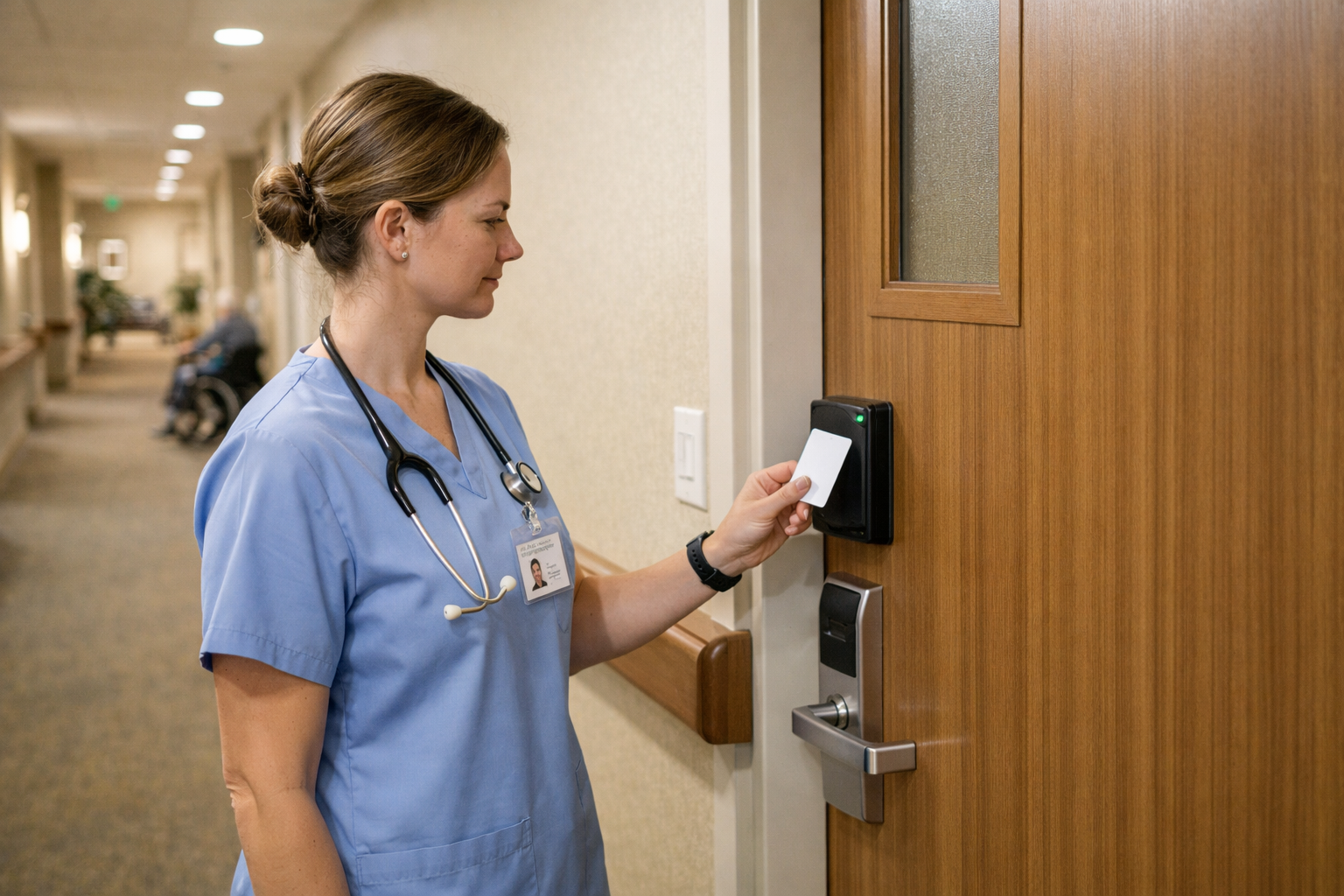
Across Canada, long-term care homes are expected to have controlled access at entrances and exits, especially where residents may be at risk of wandering.

But “controlled” doesn’t mean “locked down.”

It means:

  • Doors can restrict access when needed
  • Staff can override instantly
  • Movement is monitored, not prevented entirely
  • Systems adapt to different times, roles, and situations

A well-designed system allows:

  • Immediate unlocking during emergencies
  • Free movement within safe zones
  • Restricted access to unsafe or sensitive areas

Secure Zones: Not All Doors Should Be Equal

One of the biggest misconceptions in LTC security is treating all doors the same.

Modern systems divide facilities into intelligent zones, such as:

  • Resident living areas
  • Medication rooms
  • Staff-only corridors
  • Mechanical or service rooms
  • Controlled exits

With solutions like OMNIA Access Control, facilities can:

  • Assign permissions based on staff roles
  • Create time-based access rules
  • Track movement with audit trails
  • Trigger automated responses (alerts, door unlocks, etc.)

This ensures staff have access where needed, residents remain protected without unnecessary restrictions, and overall risk is reduced without creating an environment that feels locked or institutional.

Supporting Resident Freedom Through Smart Design

The goal is not restriction—it’s safe independence.

Access control supports this by:

  • Allowing residents to move freely within safe areas
  • Preventing unsupervised exits in high-risk cases
  • Enabling staff to intervene quickly when needed

For example when a resident approaches a controlled exit, the system automatically logs the event and can trigger an alert. Staff are notified in real time, allowing them to respond immediately and manage the situation proactively rather than reactively.

When integrated with video surveillance systems like CathexisVision, staff can:

  • Respond faster with better context
  • Visually verify events immediately
  • Reduce false alarms

The Role of Intercom and Entry Systems

Front entrances in LTC facilities are critical control points.

Modern intercom solutions, such as Akuvox smart intercom systems, add another layer of intelligence:

  • Video verification of visitors
  • Mobile-based access for staff
  • Remote unlock capabilities
  • Integration with access control platforms

This allows facilities to:

  • Reduce reliance on manual supervision
  • Maintain secure perimeters
  • Improve visitor experience

Integration: Where Access Control Becomes Powerful

Individually, each system provides value.
Together, they transform operations.

An integrated LTC security environment combines:

  • Access control (OMNIA)
  • Video surveillance (CathexisVision VMS)
  • Intercom systems (Akuvox)

This enables:

  • Event-driven automation (door + video + alerts)
  • Centralized monitoring
  • Faster response times
  • Better reporting and compliance tracking

Instead of isolated systems, facilities gain a connected security ecosystem.

Applied Use

In a typical real-world scenario, a secured exit door is accessed outside normal hours. With an integrated system in place, the door event is automatically logged in OMNIA, while CathexisVision instantly displays nearby camera footage. At the same time, staff receive a real-time alert, enabling an immediate and informed response. Without this level of integration, the same situation would rely on manual monitoring, likely result in delayed response, and ultimately increase overall risk.

Staff Efficiency and Operational Impact

Access control doesn’t just improve safety—it improves workflows.

Benefits include:

  • Reduced need for manual door monitoring
  • Faster incident response
  • Clear audit trails for investigations
  • Simplified credential management

This allows staff to focus on what matters most:

  • Resident Care

Designing the Right System for Long-Term Care

Every LTC facility is different. The right solution depends on:

  • Facility size and layout
  • Resident needs and risk levels
  • Staffing structure
  • Regulatory requirements

A well-designed system should be:

  • Scalable
  • Easy to manage
  • Fully integrated
  • Built for healthcare environments

Access control in long-term care is not about simply locking doors—it’s about creating safer, smarter environments where residents can live with dignity and confidence.

By combining intelligent access control, integrated video surveillance, and modern intercom systems, facilities can achieve what matters most: strong security without sacrificing resident freedom.

Access Control in Long-Term Care: Balancing Safety and Freedom

Share:

  • Share on Twitter Share on Twitter
  • Share on Facebook Share on Facebook
  • Share on LinkedIn Share on LinkedIn
  • Share via Email Share via Email

Frequently Asked Questions (FAQs)

What is access control in long-term care?

Access control systems manage who can enter or exit specific areas within a care facility, improving safety while maintaining operational efficiency.

Why are controlled doors important in LTC homes?

They help prevent wandering, protect vulnerable residents, and ensure only authorized individuals access sensitive areas.

How does video surveillance support access control?

Video systems like CathexisVision provide visual verification of events, helping staff respond faster and more accurately.

What role do intercom systems play?

Intercoms like Akuvox allow secure visitor management, remote access, and improved communication at entry points.

Contact Us

PMT Security Inc. is here to help, contact us directly by phone,

USA +1 727-786-1900
CAD +1 647-999-4644

Monday-Friday, 8am-5pm Eastern

Knowledge Database
Technical Support
Download Center
  • Facebook
  • LinkedIn
  • Twitter

PMT Security

Copyright © 2026 PMT Security, Inc. | All Rights Reserved

  • Privacy Policy
  • Terms of Use
  • Cookie Policy
  • Accessibility
  • Contact Us