Using Akuvox Smart Intercom in K–12 Schools: Practical Entry Control Without Overcomplicating the Campus
K–12 school security cannot rely on a single device at the front entrance. Schools have constant movement throughout the day: students arriving, staff using side doors, parents checking in, vendors making deliveries, after-hours programs accessing specific areas, and emergency responders needing reliable entry when every second matters.
This is why intercom technology is most effective when it is part of a broader, layered security strategy. The Partner Alliance for Safer Schools’ 2025 guidance emphasizes a layered and tiered approach to school safety, covering districtwide planning, digital infrastructure, campus perimeters, building perimeters, and interior spaces. It also reinforces the importance of coordinated visitor entry procedures, access control, communications, video surveillance, detection, alarms, and response protocols.
PMT Security’s education solutions follow this same integrated model. For schools and educational institutions across Canada and the United States, PMT supports connected systems that may include access control, video surveillance, visitor management, smart intercoms, lockdown functionality, staff-only area restrictions, visitor screening, secondary-entry video verification, and centralized monitoring.
Akuvox fits into this type of environment because it is more than a video doorbell. Akuvox smart intercom systems combine video communication, two-way audio, SIP-based calling, cloud management, mobile credentials, access control features, and a range of device options that can be adapted to different school buildings and entry points. With support for technologies such as AI, SIP, Android, cloud services, mobile access, IP, Wi-Fi, 2-wire retrofit, and LTE deployment options, Akuvox can help schools modernize entry communication while working within the realities of existing infrastructure.
Akuvox for Main Visitor Entrances
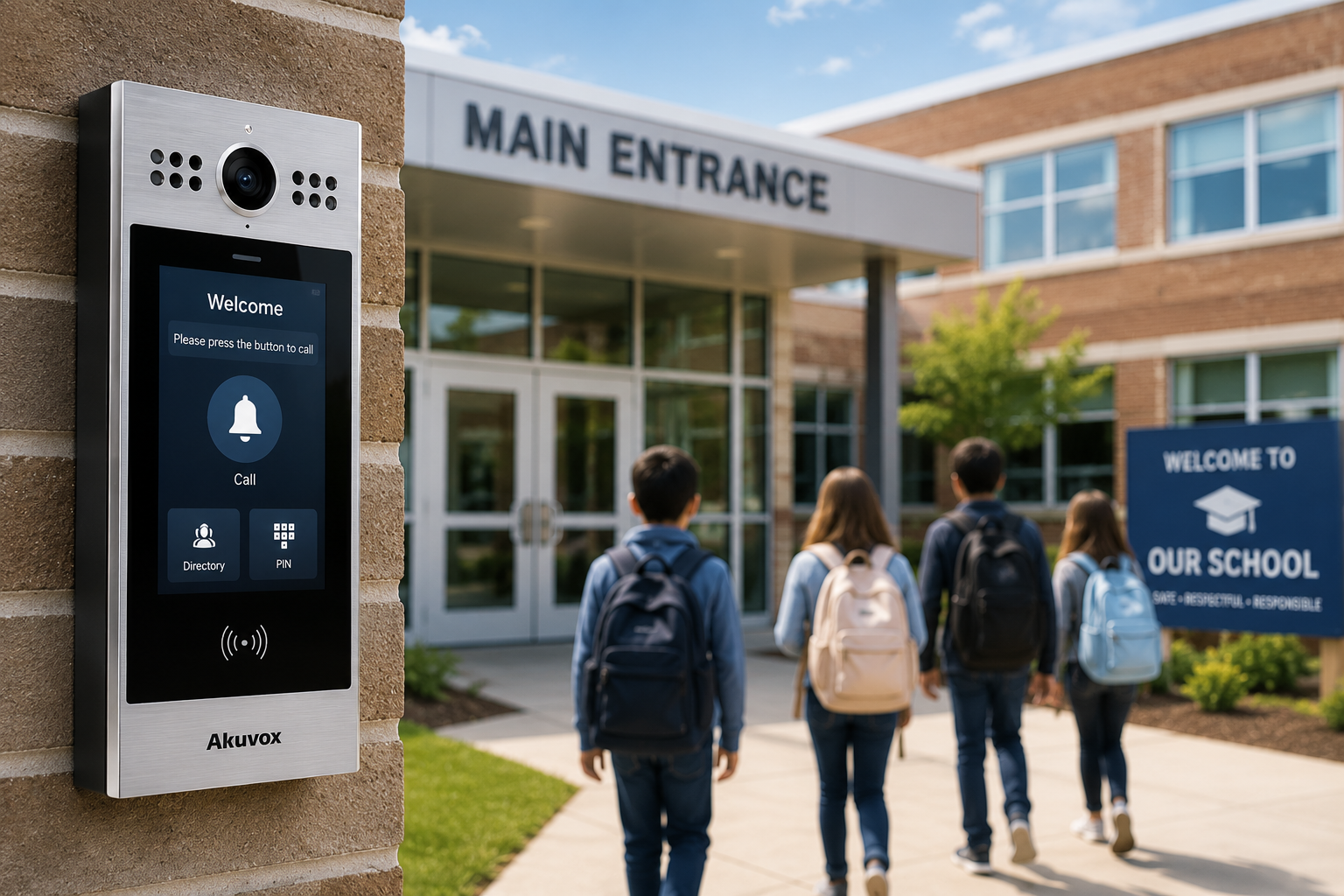
The main visitor entrance is one of the most practical places to use an Akuvox smart intercom in a K–12 school. During the school day, a locked entrance with video intercom gives office staff a way to see, speak with, and verify a visitor before access is granted.
This is especially useful in schools where the front office is not directly beside the entrance, where a secure vestibule is used, or where staff cannot leave their desk each time someone arrives. Instead of relying on an unlocked door or informal staff response, the school can create a more consistent entry process.
Akuvox door phones can support high-definition video, two-way audio, and different access methods depending on the model and system configuration. These may include mobile app access, PIN codes, cards, QR codes, NFC, facial recognition, or proximity credentials. In a school setting, these features should be applied carefully. Staff access, contractor access, and after-hours authorized access may benefit from credential-based entry, while student-facing use should always be reviewed against school board policies, privacy requirements, and age-appropriate safety practices.
Supporting Secondary School Entrances
Many schools have more than one active entrance. Staff doors, delivery doors, portable classroom access points, athletic entrances, child care areas, and maintenance doors may all be used during a regular school day. These secondary entrances can become difficult to manage because they are operationally necessary but not always easy to supervise.
Akuvox smart intercoms can help schools add video verification and controlled door release to these areas. When combined with access control rules and clear staff procedures, an intercom can reduce informal habits such as propping doors open or opening doors without knowing who is outside.
This flexibility matters because school buildings are rarely uniform. A newer front entrance, an older wing, a portable classroom area, a staff parking gate, and a service entrance may all require different hardware and network options. Akuvox offers a range of devices, including SIP video door phones, vandal-resistant door phones, LTE video door phones, facial recognition terminals, and emergency intercom devices, allowing the system design to match the location instead of forcing one device type across the entire campus.
Improving Visitor Management Workflows
A video intercom should not replace visitor management. It should support it.
One common weakness in school entry control is the gap between unlocking the door and properly checking in the visitor. Video intercom helps staff confirm who is requesting access, but schools still need a process for identifying visitors, recording visits, issuing badges, applying policies, and maintaining an audit trail.
In a practical K–12 workflow, a visitor presses the Akuvox intercom at the main entrance. Office staff visually verify the visitor and speak with them before allowing access to the vestibule or main office. From there, a visitor management system such as EVTrack can support ID capture, visitor registration, badge printing, reporting, and recordkeeping.
This creates a stronger process than simply unlocking a door from a desk phone. It helps schools connect entry communication with visitor accountability.
Remote Access for After-Hours School Use
Schools are active well beyond the regular school day. Gyms, libraries, meeting rooms, child care spaces, fields, and classrooms may be used by staff, community groups, contractors, or approved after-hours programs.
This is where remote intercom and mobile access can be helpful, but only when permissions are tightly managed.
Akuvox SmartPlus allows authorized users to see and speak with visitors, monitor entrances, open doors, and issue virtual keys from a smartphone. Akuvox access management tools can also support user records, device management, access control settings, and access logs.
In a school environment, remote access should be based on roles, schedules, and accountability. A principal, facility manager, caretaker, or board-approved administrator may need remote visibility or controlled unlock capability. That does not mean every staff member should have the same permissions. The safest approach is role-based access, time-based permissions, and reviewable event logs.
Important Design Considerations for K–12 Schools
Akuvox can support school security, but the design must reflect how schools actually operate.
First, the intercom should be connected to the broader access control strategy. Intercom events, door releases, staff credentials, visitor records, and video verification should not sit in separate silos when integration is possible. A coordinated system gives administrators and security teams better context when reviewing incidents or improving procedures.
Second, privacy must be considered from the beginning. Features such as video recording, facial recognition, mobile credentials, and access logs may be useful, but schools must align them with board policy, consent requirements, data retention rules, and local privacy expectations. In many K–12 environments, the most appropriate starting point is visitor verification, staff access, controlled entry, and audit logging—not unnecessary student surveillance.
Third, device placement matters. Outdoor intercoms need to be positioned for visibility, accessibility, weather exposure, glare, sound quality, and vandal resistance. Interior monitors, desk phones, or mobile response tools should be placed where staff can respond quickly without disrupting front office operations.
Fourth, staff training is essential. A video intercom is only effective if staff know how to use it properly. Procedures should define who can be admitted, when access should be denied, how deliveries are handled, how after-hours access is approved, and how intercom activity is reviewed.
How Akuvox Fits Into a PMT Security School Design
A practical school security design may include Akuvox video intercoms at the main entrance and selected secondary entrances, OMNIA access control for staff credentials and secure areas, EVTrack visitor management for check-in and reporting, and video management for visual verification and investigations.
In this type of layered system, Akuvox is not the entire security solution. It becomes the communication and verification layer at key access points.
The result is a more consistent entry process, clearer visitor handling, better support for after-hours activity, and stronger accountability. It can also reduce everyday workarounds that happen when doors are inconvenient, staff are busy, or entry points are difficult to monitor.
For K–12 schools, Akuvox is best understood as a smart intercom and entry communication layer. It is most useful at visitor entrances, staff doors, remote gates, portable classroom areas, service entrances, and after-hours access points.
When combined with access control, visitor management, video verification, privacy-aware policies, and staff training, Akuvox can help schools make entry decisions more visible, consistent, and manageable.
The goal is not to make a school feel locked down. The goal is to support safer, clearer, and more accountable access without interrupting the daily work of teaching, learning, and caring for students.e more efficiently, and maintain visibility across complex industrial operations.
Share:
Frequently Asked Questions (FAQs)
Akuvox smart intercom systems can be used to help schools manage visitor entry, staff access, secondary entrances, remote gates, delivery doors, portable classroom areas, and after-hours access points. They provide video communication, two-way audio, and controlled door release so staff can verify who is requesting entry before allowing access.
No. Akuvox should support visitor management, not replace it. A video intercom helps school staff see and speak with visitors before granting access, while a visitor management system records the visit, captures identification, issues badges, applies policies, and maintains an audit trail.
Akuvox intercoms are most useful at the main visitor entrance, staff entrances, delivery doors, portable classroom areas, service entrances, parking gates, and other access points that are difficult to supervise. Device placement should consider visibility, weather, glare, accessibility, sound quality, vandal resistance, and staff response time.
Yes. Akuvox can support after-hours access for authorized staff, caretakers, contractors, community groups, or approved programs. Remote access should be configured with role-based permissions, time-based schedules, and reviewable logs so that access remains controlled and accountable.
Yes. Akuvox offers different deployment options that may help in retrofit environments, including IP, Wi-Fi, 2-wire retrofit, and LTE options depending on the device and site conditions. This can be useful for older schools, detached entrances, gates, portables, or areas where running new cabling is difficult.
Depending on the model and configuration, Akuvox devices may support access methods such as PIN codes, proximity cards, NFC, QR codes, mobile app access, facial recognition, or other credential options. In schools, these features should be configured carefully and aligned with board policy, privacy requirements, and appropriate user groups.
Facial recognition may be available on some Akuvox devices, but schools should evaluate its use carefully. Any use of facial recognition should be reviewed against school board policy, consent requirements, privacy legislation, data retention practices, and age-appropriate safety standards. In many K–12 environments, visitor verification, staff access control, and audit logging may be more appropriate starting points.
Akuvox acts as the entry communication and verification layer. It works best when paired with access control, visitor management, video surveillance, lockdown procedures, staff training, and clear entry policies. This helps schools make access decisions more consistent, visible, and accountable.
Akuvox can help reduce unauthorized entry when used as part of a complete access strategy. Video intercom, controlled door release, credential-based access, access logs, and staff procedures can reduce informal practices such as propping doors open or opening doors without confirming who is outside.
The main benefit is a more controlled and consistent entry process. Akuvox helps staff verify visitors, manage secondary entrances, support after-hours access, and maintain better visibility at key access points without disrupting the daily operations of teaching, learning, and student care.
Contact Us
PMT Security Inc. is here to help, contact us directly by phone,