
Deep Sentinel and Retail Security: Moving From Recorded Evidence to Real-Time Response
Retail security has become more complex. Stores are no longer only protecting merchandise on shelves. They are also protecting employees, customers, parking areas, stockrooms, loading zones, storefronts, delivery areas, and after-hours property access.
Traditional video surveillance still plays an important role. Recorded footage supports investigations, insurance claims, internal reviews, and law enforcement reporting. But in many retail environments, recording an incident is not always enough.
A store may need to know what is happening while it is happening.
That is where live guard video monitoring, supported by AI detection and human verification, becomes relevant for the retail sector.
Why Retail Security Needs More Than Passive Camera
A passive camera records what happened. That can be valuable after a theft, break-in, vandalism event, or safety concern. However, passive surveillance often depends on someone reviewing footage after the incident is already over.
Retailers may face issues such as:
- After-hours trespassing
- Parking lot activity
- Loitering near entrances or loading areas
- Attempted break-ins
- Vandalism
- Stockroom or back-of-house concerns
- Delivery and receiving area activity
- Repeat unwanted activity near storefronts
- Employee and customer safety concerns
In these situations, the most useful security response is often the one that happens early.
The goal is not to over-secure a store or make the retail environment feel uncomfortable. The goal is to create better visibility, faster verification, and a more practical way to respond when suspicious activity occurs.
What Deep Sentinel Does Differently
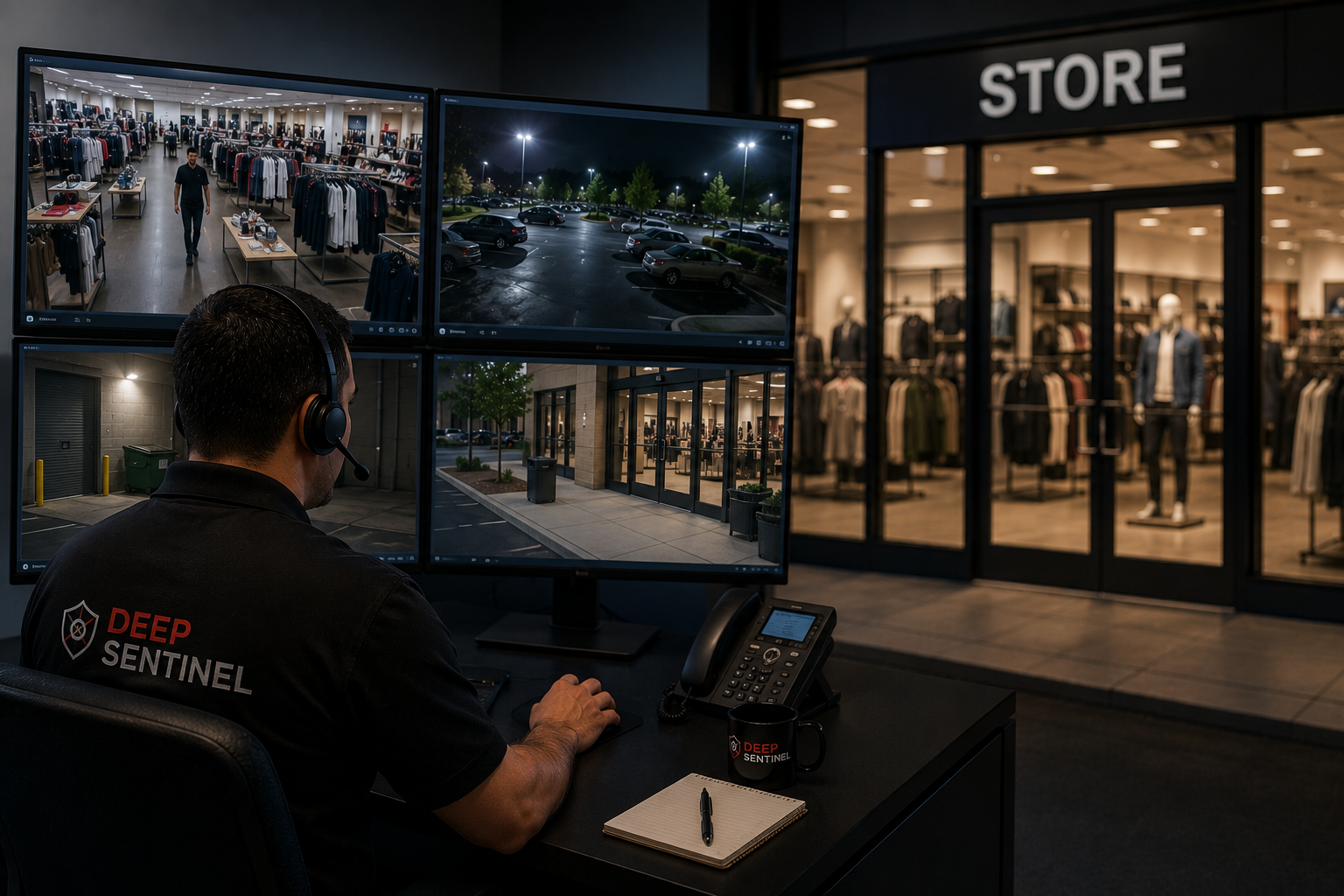
Deep Sentinel is designed around a proactive security model. Instead of relying only on recorded footage or delayed alarm notifications, the system combines AI-powered camera detection with live professional guard monitoring.
In a typical workflow:
- Cameras detect activity.
- AI helps identify whether the activity may require attention.
- A live guard reviews the event in real time.
- If needed, the guard can intervene using two-way audio or audible deterrents.
- If escalation is required, verified information can be provided to emergency responders.
This model is important because it brings human judgment into the process. AI can help detect and filter activity, but a trained person can assess context, verify what is happening, and determine whether intervention is appropriate.
For retail, that distinction matters. Not every person near a storefront is a threat. Not every after-hours movement requires police response. A verified response model helps reduce guesswork.
Retail Use Cases for Live Guard Video Monitoring
Deep Sentinel can be useful in several retail security scenarios, especially where early intervention and event verification matter.
1. After-Hours Storefront Protection
Retail properties can be vulnerable after closing. A person lingering near the entrance, checking doors, approaching windows, or moving around a closed storefront may require attention before damage occurs.
Live guard monitoring can help identify suspicious behavior and use voice-down intervention to discourage escalation.
2. Parking Lot and Exterior Visibility
Retail security often extends beyond the front door. Parking areas, side alleys, rear entrances, and walkways can all affect customer and employee safety.
A monitored exterior camera can help provide better visibility after hours or during lower-staffed periods.
3. Loading Dock and Receiving Areas
Back-of-house areas are often busy, practical spaces where deliveries, waste removal, vendor access, and employee movement overlap.
Live monitoring can help support visibility around receiving doors, storage areas, and service entrances, especially when activity occurs outside expected hours.
4. Vandalism and Property Damage Prevention
Graffiti, broken glass, damaged signage, and attempted forced entry can create repair costs and operational disruption.
A proactive monitoring workflow may help intervene before damage becomes more serious.
5. Multi-Location Retail Consistency
Retailers with multiple locations often struggle with consistency. One store may have better camera coverage than another. One site may have higher after-hours risk. Another may have recurring parking lot issues.
A live guard monitoring strategy can help create more consistent coverage across locations while still allowing each site to be configured around its own risk areas.se areas as part of one connected property instead of isolated devices.
How Deep Sentinel Fits Into an Integrated Retail Security Strategy
Deep Sentinel is not meant to replace every part of a retail security system. It works best as part of a layered security plan.
Retail environments may also use:
- Video management systems
- Access control for staff-only areas
- Intrusion detection
- Smart intercom systems
- Visitor or vendor workflows
- License plate recognition where appropriate
- Point-of-sale and video integrations
- Wireless locks for stockrooms or restricted areas
- Incident reporting and audit trails
For example, a retail store may use access control to limit staff-only areas, video surveillance to document events, and Deep Sentinel monitoring to support real-time intervention around exterior or after-hours risk points.
This layered approach is more practical than relying on a single technology to solve every problem.
The Role of Cathexis in a Unified Video Environment
Many retail organizations already have cameras and video infrastructure in place. Replacing everything at once is not always practical or necessary.
This is where video management integration becomes important.
CathexisVision is an open video management platform that can support a wide range of camera hardware, analytics, event handling, search, mapping, and export workflows. When combined with compatible Deep Sentinel monitoring, retailers may be able to add proactive monitoring to selected camera areas without rebuilding the entire system from scratch.
This can be useful for retailers that want to strengthen specific risk points such as storefronts, loading areas, parking lots, or after-hours entry zones.
Reducing False Alarms With Human Verification
False alarms are a major challenge in security operations. They can waste staff time, frustrate emergency responders, and reduce confidence in the system.
Deep Sentinel’s model uses both AI and live guard review to help determine whether activity is routine, harmless, suspicious, or urgent.
For retail, this can be especially helpful because environments are active and variable. A delivery driver, employee, customer, cleaning crew, passerby, or contractor may all appear on camera. Human verification helps separate normal activity from events that need attention.
Supporting Employee and Customer Safety
Retail loss prevention is not only about merchandise. Employee and customer safety are central concerns.
Retail workers may be the first to experience aggressive behavior, threats, vandalism, or after-hours safety concerns. A proactive monitoring system can help support a safer environment by adding another layer of visibility and response.
This does not remove the need for staff training, clear policies, good lighting, store design, access control, or management procedures. However, it can strengthen the overall safety plan by helping detect and respond to concerning activity earlier.
Best Practices for Retail Deployment
A strong live guard video monitoring plan should begin with the store layout and real risk points.
Retailers should consider:
- Which areas are most vulnerable after hours?
- Where does suspicious activity usually begin?
- Are storefront windows, doors, or display areas exposed?
- Are loading docks and receiving doors visible?
- Are parking lots or rear entrances adequately covered?
- Which cameras should be monitored live?
- Which cameras are better suited for recording only?
- What should trigger guard intervention?
- Who should be notified after an event?
- How should video clips and incident reports be stored?
The best results usually come from focused coverage, not simply adding more cameras. Camera placement, lighting, field of view, network reliability, and response procedures all matter.
Privacy and Policy Considerations
Retailers should use video monitoring responsibly. That includes clear internal policies around where cameras are placed, who can access footage, how events are reviewed, how long video is retained, and how employee or customer privacy is protected.
In general, security cameras should be focused on legitimate safety, security, and operational needs. Sensitive areas should be avoided, and access to video should be limited to authorized users.
AI and live guard monitoring should support clear security procedures, not replace human judgment or responsible policy.
Where PMT Security Fits
PMT Security supports integrated retail security environments across North America, including video surveillance, access control, visitor and vendor workflows, intercom systems, and live guard video monitoring.
For retail environments, Deep Sentinel can be part of a broader strategy that combines AI detection, human verification, real-time intervention, and video evidence. When paired with platforms such as CathexisVision and access control solutions such as OMNIA, retailers can build a more connected approach to safety, loss prevention, and operational visibility.
The focus is not simply adding more technology. The focus is helping each system work together in a practical way.
Retail security is moving from passive recording toward faster, more verified response.
Deep Sentinel’s live guard video monitoring model helps retailers detect activity, verify events, intervene when appropriate, and provide better information when escalation is needed. For stores, shopping centers, multi-location retailers, and commercial retail properties, that can mean stronger after-hours protection, better exterior visibility, fewer false alarms, and more useful incident response.
The strongest retail security strategies are layered. Cameras, access control, live monitoring, staff procedures, lighting, training, and reporting all play a role.
Deep Sentinel adds one important piece to that strategy: the ability to respond while an event is still unfolding.
Share:
Frequently Asked Questions (FAQs)
Deep Sentinel live guard video monitoring combines AI-powered camera detection with trained live guards who review events in real time and can intervene using two-way audio, audible deterrents, or verified escalation when needed.
Deep Sentinel can help retail stores monitor exterior areas, storefronts, parking lots, loading docks, and after-hours activity. It supports faster verification and response when suspicious activity is detected.
No. Deep Sentinel is best understood as part of a layered security strategy. Retailers may still use video management systems, access control, alarms, intercoms, and incident reporting tools.
Live guard monitoring is useful because it allows suspicious activity to be reviewed and addressed while it is happening, instead of relying only on recorded footage after an incident occurs
Deep Sentinel uses AI detection and human verification to help distinguish suspicious activity from routine movement. This can reduce unnecessary escalation and provide better context when response is needed.
Common areas include storefronts, entrances, parking lots, rear doors, loading docks, stockroom approaches, service corridors, and other exterior or after-hours risk points.