
What GIS Means in Modern Security Systems — and How It’s Used in Cathexis
Geographic Information Systems (GIS) are often associated with urban planning, utilities, or environmental science—but they are becoming increasingly relevant in physical security. As surveillance systems expand across multiple buildings, campuses, and regions, the ability to visualize security data spatially is no longer a luxury—it’s a practical necessity.
This is where GIS moves from theory into day-to-day operations.
What Is GIS (Geographic Information Systems)?
Wide At its core, GIS is a framework for capturing, managing, and visualizing data that is tied to a physical location.
Instead of looking at information as isolated data points—logs, alerts, camera feeds—GIS places that data onto a map or spatial layout. This allows users to understand not just what is happening, but where it’s happening, and how different events relate to one another geographically.
A GIS platform typically combines:
- Spatial data (coordinates, maps, floorplans, site layouts)
- Attribute data (events, alarms, device status, metadata)
- Visualization tools (interactive maps, overlays, layers)
In a security context, that means turning raw system activity into a visual environment where movement, incidents, and system states can be interpreted in real time.
Why GIS Matters in Physical Security
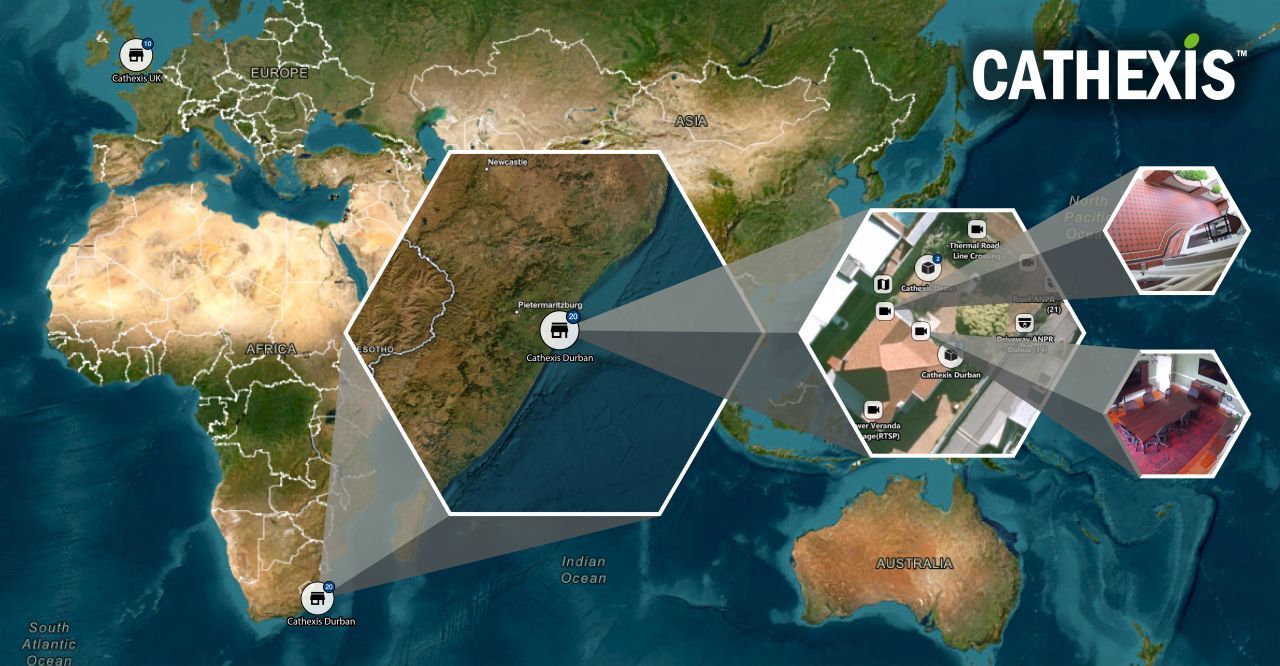
CathexisVision, an open-platform video management system used in many integrated security environments, incorporates GIS functionality to bridge the gap between video data and spatial context.
Within CathexisVision, GIS is not treated as a separate module—it’s embedded into how operators interact with the system.
Map-Based Camera Visualization
Cameras are placed directly onto digital maps or site layouts. This can include:
- Building floorplans
- Campus maps
- City or regional maps for distributed systems
Operators can click on a camera icon within the map and immediately access live or recorded video, eliminating the need to search through lists or naming conventions.
Layered System Awareness
GIS allows multiple layers of information to be displayed simultaneously, such as:
- Camera locations
- Access control points
- Alarm zones
- Perimeter boundaries
This layered approach aligns with how integrated systems are designed—where video, access control, and analytics all contribute to a single operational picture.
Event Visualization in Real Time
When an event occurs—motion detection, analytics trigger, or alarm—it can be represented visually on the map.
Instead of reading an alert and then locating the camera, operators see the event appear exactly where it’s happening. This reduces response friction and supports faster decision-making.
Multi-Site and Distributed Monitoring
For organizations managing multiple facilities, GIS enables a single interface to represent:
- Separate buildings
- Remote sites
- Regional infrastructure
Operators can zoom in and out between macro and micro views—from a country-level overview down to a single entry point—without leaving the system.
Guided Navigation and Investigation
During incident review, GIS supports:
- Tracing movement across cameras
- Understanding direction and flow of activity
- Identifying adjacent coverage areas
This becomes particularly valuable when combined with CathexisVision’s search tools and analytics, allowing investigations to move from isolated clips to contextual timelines.
Practical Benefits for Integrated Security Environments
For organizations like PMT Security, GIS functionality within CathexisVision supports how systems are designed, deployed, and used in real-world environments.
Improved Situational Awareness
Operators are not just reacting to alerts—they are seeing them within a physical environment. This reduces ambiguity and improves clarity during active situations.
Faster Response Times
When location is immediately visible, there is less delay between detection and action. This is particularly important in large or complex facilities where identifying the correct camera or access point can otherwise take time.
Scalable System Design
GIS aligns well with modern system architecture:
- Single-site installations can grow into multi-site environments
- New cameras and devices can be added spatially, not just logically
- Systems remain navigable even as complexity increases
Better Operator Experience
Security platforms are often judged by how usable they are under pressure. A GIS-driven interface reduces reliance on memory (camera names, zones) and instead leverages intuitive spatial navigation.
Stronger Integration Across Systems
Because GIS provides a shared visual layer, it naturally supports integration between:
- Video surveillance (CathexisVision)
- Access control systems
- Intercom and perimeter technologies
This reflects the broader shift toward unified security ecosystems, where systems are not siloed but contribute to a single operational view.
Where GIS Adds the Most Value
GIS (Geographic Information System) becomes particularly impactful in environments such as:
- Educational campuses with multiple buildings
- Healthcare facilities with complex layouts
- Municipal or smart-city infrastructure
- Industrial and logistics sites with large physical footprints
- Residential communities and mixed-use developments
In these environments, scale and complexity make traditional list-based monitoring inefficient.
GIS is not just a mapping tool—it’s a way of organizing and interpreting security data in a way that aligns with the real world.
In systems like CathexisVision, GIS transforms video management from a collection of camera feeds into a spatially aware platform where events, movement, and infrastructure are connected.
For integrators like PMT Security, this capability supports a more intuitive, scalable, and operationally effective approach to system design—one where technology adapts to the environment it protects, rather than forcing users to adapt to the technology
Share:
Frequently Asked Questions (FAQs)
GIS (Geographic Information Systems) in security refers to the use of maps and spatial data to visualize cameras, alarms, and events in real-world locations. It helps operators understand where incidents occur and how they relate to surrounding infrastructure.
CathexisVision uses GIS to display cameras and system events on interactive maps. Operators can access live video, monitor alarms, and navigate sites directly through a spatial interface rather than relying on lists or naming conventions.
GIS improves situational awareness by providing location-based context. It allows operators to quickly identify where events are happening, understand proximity, and respond more efficiently—especially in large or multi-site environments.
GIS reduces complexity by visualizing systems in a way that mirrors the physical environment. This leads to faster response times, easier navigation, and improved decision-making during live incidents and investigations.
Yes. GIS enhances integrated systems by providing a shared visual layer for video, access control, and alarms. This allows different technologies to be understood and managed within a single, unified interface.
Contact Us
PMT Security Inc. is here to help, contact us directly by phone,