
Access Control in Assisted Living: Safety, Dignity, and Workflow
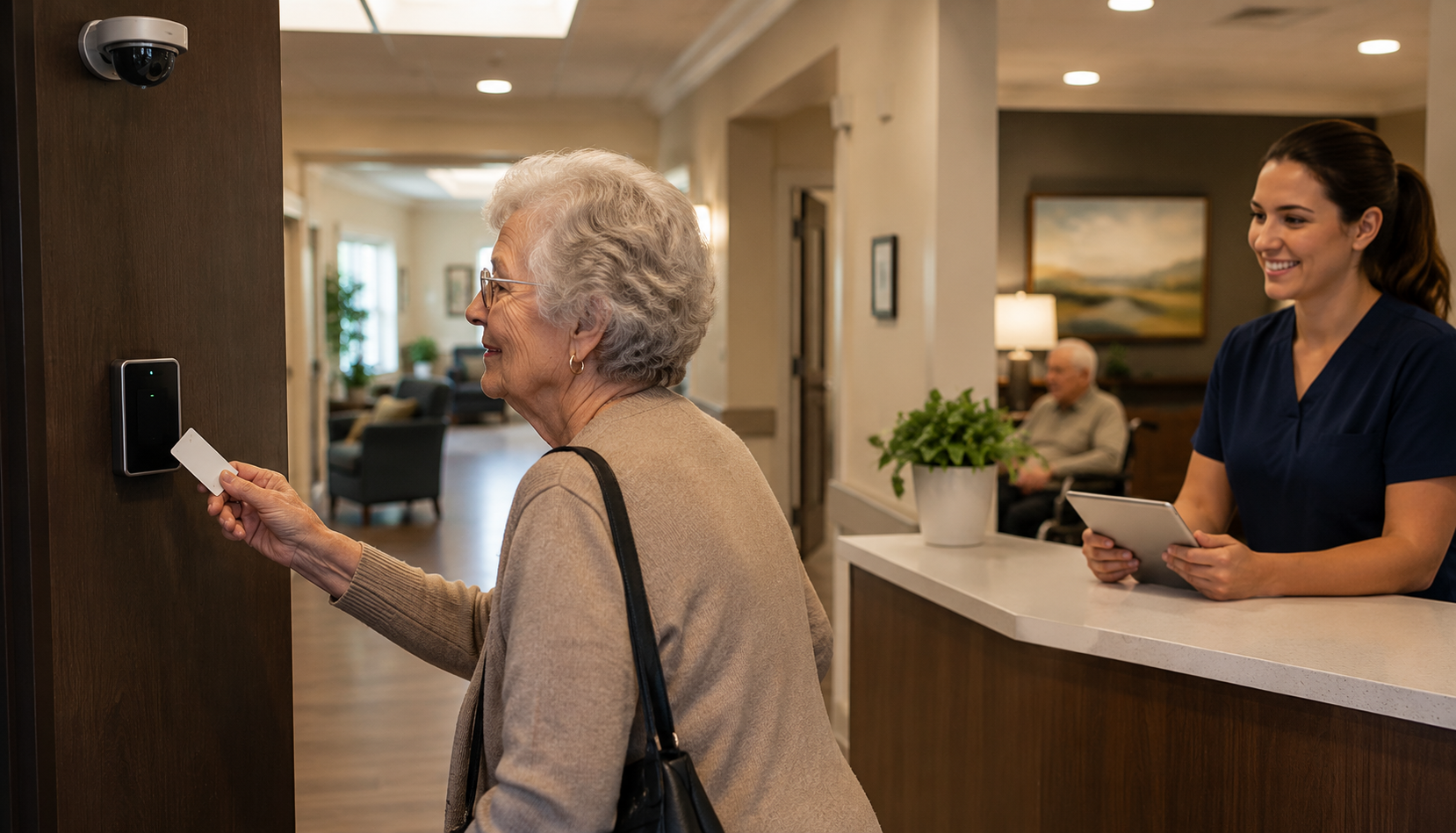
Access control in assisted living is different from access control in a warehouse, office building, or retail environment.
An assisted living facility is not just a workplace.
It is someone’s home.
Residents live there. Families visit there. Staff provide care there. Vendors, contractors, volunteers, clinicians, delivery teams, and emergency responders may all need access at different times for different reasons.
That makes security planning more complex.
The goal is not to make the building feel locked down.
The goal is to create a safer, more organized environment where access control supports resident protection, staff workflow, family trust, visitor accountability, and daily operations.
When designed thoughtfully, access control can help assisted living communities balance two important priorities:
Safety and dignity.
Why Access Control Matters in Assisted Living
Assisted living and long-term care communities manage constant movement.
Residents may move between private rooms, dining areas, outdoor spaces, activity rooms, lounges, care areas, and shared amenities. Staff move between resident spaces, medication rooms, records areas, service doors, offices, and supply areas. Visitors arrive for family visits, appointments, social activities, deliveries, maintenance, and care coordination.
Without a clear access control strategy, facilities may struggle with:
- Unsecured entrances
- Unmonitored service doors
- Inconsistent visitor procedures
- Staff using shared keys or codes
- Former staff credentials remaining active
- Vendors accessing areas outside approved work zones
- Medication or records rooms being too easy to enter
- Doors being propped open for convenience
- Controlled exits not being reviewed regularly
- Staff uncertainty during alerts or emergencies
Access control helps bring structure to these daily movements.
It can help answer important questions:
Who entered?
Which door was used?
Was access authorized?
Was the person expected?
Was the access tied to a role, schedule, or visitor workflow?
Can the event be reviewed if needed?
In assisted living, those questions are not only about security.
They are about care, accountability, and trust.
Safety Without Losing the Feeling of Home
One of the biggest challenges in assisted living security is tone.
A facility should feel welcoming, calm, and respectful. Residents and families should not feel like they are entering an institution or a restricted facility.
At the same time, the building must protect people who may be vulnerable, confused, medically fragile, or dependent on staff support.
That is where thoughtful access control matters.
The right system should help control risk points without disrupting normal life.
This may include:
- Securing staff-only areas
- Managing main entrance access
- Supporting visitor check-in
- Controlling medication rooms
- Restricting records rooms
- Monitoring service doors
- Supporting controlled exits
- Reviewing after-hours access
- Managing contractor and vendor movement
- Documenting access events when needed
The best access control design is not always the most visible one.
In care environments, security should quietly support the facility rather than dominate it.
Key Areas to Review in Assisted Living Access Control
1. Main Entrances and Visitor Access
The main entrance is one of the most important security points in an assisted living community.
It is often the first place where visitors, family members, vendors, volunteers, and contractors interact with the facility.
A strong entrance workflow may include:
- Clear visitor check-in procedures
- Staff-controlled entry
- Video intercom communication
- Visitor management records
- ID verification where appropriate
- Temporary access permissions
- Visitor badges or digital sign-in
- Access control event history
- Video context for entry events
The front entrance should be welcoming, but it should not be informal.
Paper sign-in sheets, unlocked front doors, shared access codes, or inconsistent visitor practices can make it harder to review who entered the facility and when.
When visitor management, intercoms, access control, and video surveillance work together, the entrance becomes easier to manage and easier to review.
2. Controlled Exits and Resident Safety
Controlled exits require careful planning in assisted living environments.
Some residents may be at risk of wandering, confusion, or leaving without appropriate support. Others may be fully independent and should not feel unnecessarily restricted.
This is where facility-specific planning is important.
Controlled exit strategies may involve:
- Door alerts
- Delayed egress where appropriate and permitted
- Staff notification workflows
- Video verification
- Outdoor space monitoring
- Resident safety procedures
- Clear staff response instructions
- Documentation of exit events
- Emergency override planning
A controlled exit is not only a hardware decision.
It is a care workflow.
Staff need to know what an alert means, who responds, how quickly they respond, and what to do when they arrive.
The technology should support that response.
3. Medication Rooms, Records Rooms, and Staff-Only Areas
Assisted living facilities often include spaces that should be limited to authorized staff.
These may include:
- Medication rooms
- Records rooms
- IT closets
- Mechanical rooms
- Storage areas
- Staff offices
- Laundry or service areas
- Clinical supply rooms
- Maintenance rooms
Access control helps ensure that only approved users can enter these areas.
It also creates an audit trail.
If a medication room is accessed after hours, or a records room is opened outside normal workflow, the facility can review the event. That does not automatically mean something is wrong, but it gives leadership and care teams better visibility.
For sensitive areas, access control should support accountability.
4. Staff Access and Credential Management
Staff movement is central to assisted living operations.
Care staff, administrative staff, maintenance teams, food service staff, cleaning teams, management, and security personnel may all need different access levels.
A well-managed access control system should support:
- Individual credentials
- Role-based permissions
- Time-based access
- Fast credential removal for former staff
- Temporary access for new or agency staff
- Separate permissions for restricted rooms
- Administrator permission review
- Audit trails for staff access
- Reporting by door, user, time, or event
Shared keys, shared codes, and informal permissions can create accountability gaps.
Individual credentials help facilities understand who accessed which area and when.
This matters during investigations, staffing changes, audits, and daily operations.
5. Vendors, Contractors, and Service Doors
Assisted living communities rely on many external service providers.
These may include:
- Medical suppliers
- Food service deliveries
- Laundry services
- Maintenance contractors
- IT providers
- Cleaning crews
- Inspectors
- Equipment vendors
- Repair technicians
- Transportation providers
These users may need access, but not unlimited access.
Access control can help limit contractor and vendor access by:
- Door
- Time
- Date
- Role
- Work order
- Escort requirement
- Temporary credential
- Approved area
Service doors and delivery entrances are especially important.
A delivery door that is frequently propped open can create a security gap. A contractor credential that remains active after work is complete can create unnecessary risk. A side entrance used without documentation can make review difficult later.
Vendor access should be convenient enough to support operations, but structured enough to maintain accountability.. A well-planned intercom can help staff manage entry more confidently.
Access Control Works Best When Connected
Access control is powerful on its own, but in assisted living it becomes more useful when connected to other parts of the security environment.
This is the core idea behind PMT Security.
A single event may involve multiple systems.
A visitor arrives.
An intercom call is placed.
Staff verify the person.
Visitor management records the visit.
Access control releases the door.
Video provides context.
A report supports review if needed.
That is a connected security workflow.
The same is true for a controlled exit alert, after-hours access event, service door issue, or restricted room entry.
The goal is not more technology.
The goal is better context.
Access Control and Video Context
An access control event tells you that a door was used.
Video can help show what happened.
For example, video context can help answer:
- Was the credential holder actually present?
- Did someone follow behind them?
- Was the door propped open?
- Did the person enter alone?
- Was the event connected to a delivery or staff task?
- Did the door close properly?
- Was the event unusual for that time of day?
This can be especially useful for:
- Main entrances
- Controlled exits
- Service doors
- Medication rooms
- Parking entrances
- Outdoor spaces
- After-hours access
- Visitor areas
Video context makes access control events easier to understand.
Access Control and Visitor Management
Visitor management helps document who is entering the facility and why.
Access control helps manage where and when entry is allowed.
Together, they can support a stronger entrance workflow.
For assisted living communities, visitor management can help track:
- Family visits
- Contractors
- Vendors
- Volunteers
- Inspectors
- Healthcare providers
- Transportation providers
- Temporary guests
When visitor records and access permissions are aligned, facilities gain a clearer picture of non-employee movement.
This can support daily accountability, emergency awareness, and post-event review.
Access Control and Smart Intercoms
Smart intercom systems can help staff see and speak with people before allowing entry.
This is especially useful at:
- Main entrances
- After-hours entrances
- Delivery doors
- Parking gates
- Remote entrances
- Secondary buildings
- Staff-only doors
An intercom should not be treated as a simple doorbell.
In assisted living, it can be part of a controlled entry process that supports visitor verification, staff communication, remote door release, and safer access decisions.
Access Control and Networking
Modern access control often relies on network connectivity.
Controllers, workstations, visitor management stations, intercoms, cameras, wireless access points, and remote monitoring tools may all depend on stable network communication.
If the network is unreliable, the security system becomes harder to support.
Facilities should consider:
- Device connectivity
- PoE requirements
- Network documentation
- Remote support
- Switch capacity
- Backup power
- Camera and intercom connectivity
- Network monitoring
- Multi-site visibility
The network should not be treated as background infrastructure.
It is part of the security system.
Workflow Matters as Much as Hardware
Access control should be designed around how the facility actually operates.
Before adding or changing technology, assisted living facilities should review daily workflows.
Important questions include:
- How do visitors enter?
- Who approves entry after hours?
- Which doors are used by staff?
- Which doors are used by deliveries?
- Which areas require restricted access?
- Which residents may need exit support?
- What happens when a door alert occurs?
- Who reviews access reports?
- How are former staff credentials removed?
- How are temporary workers handled?
- How are emergency responders considered?
- How are family visits documented?
- How are vendors and contractors controlled?
Technology should support the answers to these questions.
A system that ignores workflow will create frustration. A system that supports workflow can improve safety and reduce confusion.
Common Access Control Mistakes in Assisted Living
Treating Every Door the Same
A main entrance, medication room, resident exit, delivery door, staff entrance, and outdoor gate each have different risks and uses.
Access control should reflect those differences.
Relying on Shared Codes
Shared codes are easy to distribute and hard to control.
If too many people know the same code, it becomes difficult to know who entered and whether access should still be active.
Forgetting About Former Staff and Contractors
Credentials should be removed quickly when staff leave or when contractor work is complete.
Inactive users and old credentials should be reviewed regularly.
Ignoring Door-Held-Open Events
A door that is frequently held open may reveal a workflow problem, hardware issue, training gap, or delivery challenge.
These events should not be ignored.
Missing Video Context
Access control logs are useful, but they do not always explain what happened.
Video context can make review faster and more accurate.
Not Training Staff on Alerts
An alert is only useful if staff know what it means and how to respond.
Access control planning should include clear staff procedures.
Building a Better Access Control Plan
Many school entrance issues are not caused by a lack of concern. They happen because daily routines become busy, systems are disconnected, or procedures are difficult to follow.
Common gaps include:
- Visitors entering through side doors
- Staff propping doors open
- Paper sign-in sheets with incomplete records
- Shared keys or PINs
- Unclear visitor badge procedures
- No consistent check-out process
- Former staff credentials not removed quickly
- Contractors receiving too much access
- Intercoms with poor audio or camera angles
- Doors without video context
- Entrance procedures that change from one staff member to another
- Limited reporting when an incident occurs
A connected school entrance security plan can help reduce these gaps by making the expected process easier to folloA practical access control plan for assisted living should include:
- A door-by-door review
- Visitor workflow review
- Staff credential policy
- Contractor access rules
- Controlled exit procedures
- Emergency response planning
- Video coverage review
- Intercom routing review
- Network readiness review
- Reporting schedule
- Credential removal process
- Staff training
- Regular system review
This does not need to be overwhelming.
Start with the doors and workflows that create the most risk.
Then build a system that supports the facility’s care environment.
Access Control Should Support People
In assisted living, access control is not just about buildings.
It is about people.
Residents should feel respected.
Families should feel confident.
Staff should feel supported.
Visitors should understand the process.
Administrators should have accountability.
Emergency responders should be considered.
Vendors should have appropriate access.
Security teams should have context.
A well-designed access control system can support all of these needs.
It can reduce confusion, improve visibility, support response, and help facilities maintain a safer environment without sacrificing warmth or dignity.
Access control in assisted living is about balance.
Safety matters.
Dignity matters.
Workflow matters.
The strongest systems do not simply restrict movement. They support better decisions.
When access control is connected with video surveillance, visitor management, smart intercoms, networking, reporting, and staff procedures, assisted living communities gain more than locked doors.
They gain visibility, accountability, and context.
That is the purpose of connected security.
PMT Security helps organizations and integrators support access control, video surveillance, visitor management, smart intercoms, cloud-managed networking, live monitoring, and integrated physical security solutions designed for real-world care environments.
Share:
Frequently Asked Questions (FAQs)
Access control helps assisted living communities manage who can enter certain doors, areas, or rooms. It supports resident safety, visitor accountability, staff workflow, restricted area protection, and event review.
Access control can be designed to quietly support safety without making the environment feel overly restricted. The goal is to protect residents while maintaining a welcoming, respectful, home-like atmosphere.
Common areas to review include main entrances, controlled exits, medication rooms, records rooms, staff-only areas, service doors, delivery entrances, IT rooms, mechanical rooms, outdoor spaces, and parking gates.
Visitor management documents who is entering the facility and why, while access control helps manage where and when entry is allowed. Together, they support stronger accountability for family members, vendors, contractors, volunteers, and temporary visitors.
Video provides context for access control events. It can help confirm who was present, whether someone followed behind, whether a door was propped open, and what happened before or after an event.
Common mistakes include relying on shared codes, failing to remove old credentials, treating every door the same, ignoring door-held-open events, not connecting access events to video, and not training staff on alert response.