School Entrance Security: Intercom, Visitor Management, and Access Control
A school entrance is more than a door.
It is the first point of contact for visitors, parents, vendors, contractors, volunteers, staff, students, and sometimes emergency responders. It is also one of the most important places where safety, communication, policy, and daily operations meet.
For many schools, the front entrance has changed significantly. A simple unlocked door, buzzer, paper sign-in sheet, or office window is no longer enough to support the level of visibility and accountability schools need today.
Modern school entrance security depends on connected systems.
Intercoms help staff see and speak with a person before entry.
Visitor management systems help record and manage who is on-site.
Access control helps determine which doors can open, when, and for whom.
Video surveillance helps provide context when events need to be reviewed.
When these tools work together, schools can create a safer and more organized entry process without making the building feel unwelcoming.
That balance matters.
The goal is not to make schools feel closed off. The goal is to help staff make better entry decisions, reduce confusion, improve accountability, and protect the daily learning environment.
What Is School Entrance Security?
School entrance security refers to the systems, procedures, and physical design choices used to manage how people enter a school building.
A strong entrance security plan may include:
- Controlled exterior doors
- A main visitor entrance
- Video intercom communication
- Remote door release
- Visitor check-in procedures
- ID verification
- Badge printing
- Access control credentials
- Door schedules
- Video surveillance
- Staff training
- Emergency procedures
- Audit logs and reporting
The best school entrance security plans are layered. They do not rely on one device or one person. Instead, they combine technology, policy, and procedure to support safer daily operations.
Why the School Entrance Matters
The school entrance is often the most active security point in the building.
During a normal day, it may handle:
- Student arrivals
- Late arrivals
- Parent drop-offs
- Visitors
- Deliveries
- Contractors
- Volunteers
- Substitute teachers
- Community program access
- After-hours activities
- Emergency response
Each of these groups may require a different level of access.
- A parent attending a meeting may need to enter the office but not student areas.
- A delivery driver may need access to a receiving area but not the main building.
- A contractor may need temporary access during specific hours.
- A staff member may need access to certain doors every weekday.
- An after-hours program may need access to one area but not the entire school.
This is where connected security becomes important.
A school entrance should not rely only on someone recognizing a face or pressing a door release button. Staff need a process that helps them verify, record, and manage access in a consistent way.
Intercoms: The Communication Layer
A busy manufacturing facility can generate a large amount of video. WAn intercom is often the first active step in the school entry process.
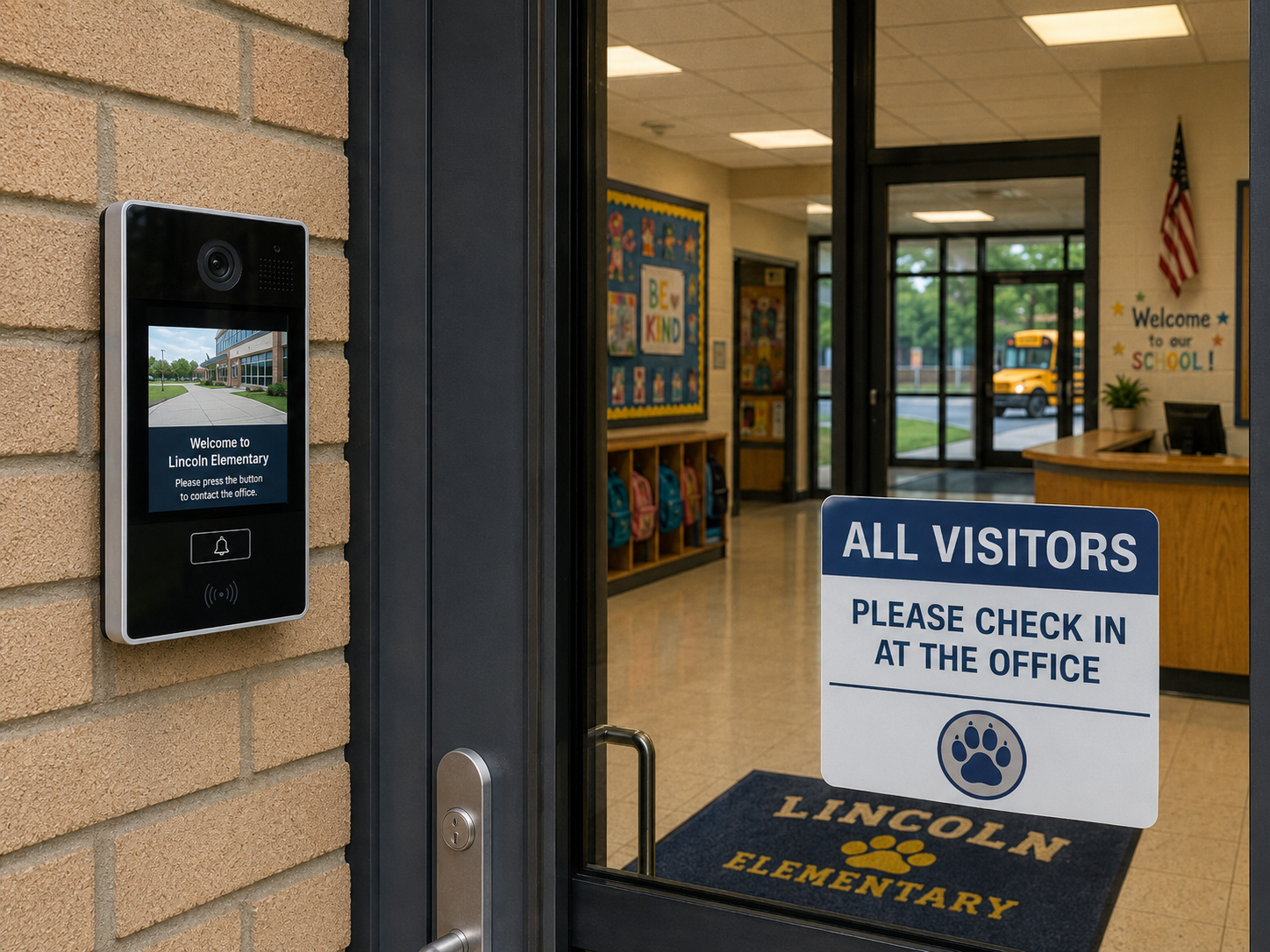
Before a visitor enters, office staff need to know who is at the door and why they are there. A modern video intercom can help staff see, speak with, and verify the person requesting entry.
For schools, an intercom may support:
- Main visitor entrance communication
- Locked front door entry
- Delivery door communication
- Staff entrance assistance
- Portable classroom access points
- Remote gates
- After-hours program entry
- Service entrance communication
A school intercom should be clear, reliable, and easy for staff to use. Audio quality matters. Camera placement matters. Lighting matters. Weather protection matters. Accessibility matters.
A poorly placed intercom can create frustration. A well-planned intercom can help staff manage entry more confidently.
Why an Intercom Should Not Work Alone
An intercom allows communication, but communication is not the same as full visitor management.
For example, a visitor may press the call button, speak with office staff, and be allowed inside. But what happens next?
Was the visitor’s name recorded?
Was their purpose documented?
Was identification checked?
Was a badge issued?
Was the visit connected to a host?
Did the visitor check out?
Can the school review the visit later?
This is why an intercom should support a wider entry process. It helps staff decide whether a person should be allowed to approach the next step. It does not replace visitor management, access control, or school policy.
For PMT Security, Akuvox smart intercom solutions fit into this part of the school security environment. They can support video communication, two-way audio, access control features, mobile access options, and flexible deployment for different school entry points.
In a school setting, the intercom is best understood as the communication and verification layer.
Visitor Management: The Accountability Layer
Visitor management is where the entry process becomes documented.
A paper sign-in sheet may collect a name, but it usually does not provide strong verification, reporting, real-time visibility, or consistent policy enforcement.
A modern visitor management system can help schools manage visitor activity more clearly.
Visitor management may support:
- Visitor check-in
- ID scanning
- Photo capture
- Badge printing
- Host notification
- Pre-registration
- QR code check-in
- Contractor records
- Volunteer records
- Visitor check-out
- Reports and audit trails
- Real-time visibility into who is on-site
This is especially important in schools because visitors are not all the same.
A parent, vendor, volunteer, contractor, substitute teacher, delivery driver, and community group member may each require a different workflow. Visitor management helps create structure around that movement.
PMT Security’s EVTrack visitor management solution supports secure guest and staff entry using tools such as ID scanning, QR codes, self-service kiosks, mobile guard check-in, visitor apps, dashboards, analytics, and reporting.
For schools, that means visitor activity can become more visible and easier to review.
Access Control: The Permission Layer
Access control determines who can enter specific doors, areas, or buildings.
In schools, access control is often used for:
- Main entrances
- Staff doors
- Administrative areas
- Mechanical rooms
- IT rooms
- Records areas
- Gyms
- Cafeterias
- Portable classrooms
- Service entrances
- After-hours access points
- Shared community-use areas
Access control helps schools move away from unmanaged keys and shared access practices. Instead of giving the same key or code to many people, a school can assign individual credentials with permissions based on role, location, and schedule.
For example:
- Office staff may have weekday access to administrative areas.
- Teachers may have access to classrooms and staff entrances.
- Custodial teams may have broader after-hours access.
- Contractors may receive temporary access.
- Community groups may only access specific areas during approved times.
- Former staff credentials can be removed quickly.
This creates better control and better accountability.
PMT Security’s OMNIA access control platform supports door control, users, credentials, permissions, schedules, reporting, and integration with other security systems. In a school entrance environment, access control helps turn entry decisions into managed events rather than one-time door openings.
Why These Systems Work Better Together
School entrance security is strongest when intercom, visitor management, access control, and video are connected.
Each system answers a different question.
Intercom: Who is requesting entry?
Visitor management: Who is on-site and why?
Access control: Who is allowed through which door?
Video surveillance: What actually happened?
Reporting: Can the event be reviewed later?
When these systems are disconnected, gaps appear.
An intercom may let someone in, but the visit may not be logged.
A visitor may sign in, but access permissions may not be controlled.
A door may unlock, but staff may not have video context.
A report may show a door event, but not the person or reason behind it.
Connected systems help reduce these gaps.
For example, a stronger school entrance workflow may look like this:
- Visitor arrives at the main entrance.
- Visitor presses the video intercom.
- Office staff see and speak with the visitor.
- Staff confirm the purpose of the visit.
- Door access is granted only to the appropriate entry point.
- Visitor checks in through the visitor management system.
- Identification is verified according to school policy.
- A badge is issued.
- The visit is connected to a host or destination.
- The visitor checks out when leaving.
- The event can be reviewed if needed.
This is not about adding steps for the sake of complexity. It is about making entry decisions clearer, more consistent, and easier to support.
Video Context at the Entrance
Video surveillance plays an important role in school entrance security, especially when connected to access events, intercom calls, or visitor records.
Video can help schools review:
- Who approached the entrance
- When a visitor arrived
- Whether a door was held open
- Whether someone entered behind another person
- Whether a delivery was made
- Whether a visitor moved beyond approved areas
- Whether an incident occurred near the entrance
CathexisVision video management can support live monitoring, event review, analytics, search, and investigation workflows. When video is connected to door events or visitor activity, it becomes more useful than standalone footage.
The goal is not simply to collect more video. The goal is to make video easier to use when context matters.
The Importance of a Main Visitor Entrance
Many schools benefit from a clearly defined main visitor entrance during school hours.
A main visitor entrance helps direct visitor activity through one managed process. It also reduces confusion for parents, contractors, volunteers, and delivery personnel.
A strong main entrance plan may include:
- Clear visitor routing
- Locked exterior doors
- Video intercom communication
- Camera coverage
- Controlled door release
- A vestibule or reception area where possible
- Visitor check-in
- Badge issuance
- Staff training
- Emergency procedures
Secondary doors should also be reviewed. Side doors, gym doors, delivery doors, portable doors, and staff entrances can become weak points if they are not included in the security plan.
A school entrance strategy should consider the whole building, not only the front door.
Managing After-Hours Access
School security does not end when the school day is over.
Many buildings are used for:
- Sports
- Clubs
- Community programs
- Staff meetings
- Custodial work
- Maintenance
- Deliveries
- Contractor work
- Elections or public events
- Evening rentals
After-hours access should be intentional. Doors should not be left unlocked simply because a program is running. Staff should not need to prop doors open. Contractors should not receive broad access when temporary access will do.
Access control can help schools create time-based permissions for approved users and areas. Intercoms can support communication at key entry points. Visitor management can help record certain types of after-hours activity. Video can provide context if an event needs to be reviewed.
This is especially useful for multi-use school buildings where safety and community access must be balanced.
Common School Entrance Security Gaps
Many school entrance issues are not caused by a lack of concern. They happen because daily routines become busy, systems are disconnected, or procedures are difficult to follow.
Common gaps include:
- Visitors entering through side doors
- Staff propping doors open
- Paper sign-in sheets with incomplete records
- Shared keys or PINs
- Unclear visitor badge procedures
- No consistent check-out process
- Former staff credentials not removed quickly
- Contractors receiving too much access
- Intercoms with poor audio or camera angles
- Doors without video context
- Entrance procedures that change from one staff member to another
- Limited reporting when an incident occurs
A connected school entrance security plan can help reduce these gaps by making the expected process easier to follow.
Entrance Security Should Support Staff, Not Overload Them
School office staff already manage many responsibilities.
They answer phones, support families, help students, coordinate attendance, manage paperwork, respond to emergencies, and communicate with teachers and administrators. Entrance security should support them, not create a complicated process that slows the day down.
Good system design should focus on:
- Simple workflows
- Clear alerts
- Easy visitor check-in
- Fast access decisions
- Reliable intercom communication
- Useful reporting
- Minimal duplicate data entry
- Practical staff training
- Systems that fit the school’s actual routine
The strongest technology is not always the most complicated. It is the technology that supports real people making real decisions during a busy school day.
Privacy and Policy Considerations
School security systems should always be implemented with appropriate attention to privacy, policy, and local requirements.
Schools should define:
- Who can access visitor records
- How long records are retained
- Who can manage access permissions
- How video is reviewed
- How visitor information is protected
- How staff are trained
- How emergency access is handled
- How parents and visitors are informed of procedures
- How student privacy is protected
- How accessibility needs are supported
Security technology is only one part of the plan. Policy, communication, training, and review are equally important.
A Practical School Entrance Security Checklist
Schools reviewing their entrance security can begin with practical questions:
These questions help schools move from reactive security to a more structured approach.
How PMT Security Supports Connected School Entrance Security
PMT Security supports integrated school security environments that connect access control, video surveillance, visitor management, intercoms, networking, and ongoing support.
For school entrance security, this may include:
- Akuvox smart intercoms for video communication and entry verification
- EVTrack visitor management for visitor check-in, ID capture, QR codes, kiosks, and reporting
- OMNIA access control for door permissions, schedules, credentials, and event records
- CathexisVision video management for video context, monitoring, review, and investigation
- Lysora cloud-managed networking to support the connected infrastructure behind modern security systems
- PMTCare support services to help with maintenance, updates, and long-term system reliability
The value is not in using more technology. The value is in creating a connected entry process that is easier to manage, easier to review, and better aligned with the needs of the school.
School entrance security is not one product.
It is a process.
An intercom helps staff communicate.
Visitor management helps document who is on-site.
Access control helps manage permissions.
Video helps provide context.
Reporting helps support accountability.
Training helps make the process consistent.
When these pieces work together, schools can create entrance procedures that are safer, clearer, and more practical for everyday use.
That is the strength of connected school security.
Not more disconnected devices.
Better decisions at the door.
Share:
Frequently Asked Questions (FAQs)
School entrance security is the combination of systems and procedures used to manage how people enter a school building. It may include intercoms, access control, visitor management, video surveillance, locked doors, badges, staff training, and emergency procedures.
A video intercom helps school staff see and speak with a visitor before allowing entry. It supports better verification at the door and can help reduce unnecessary or unauthorized access.
No. An intercom helps staff communicate with a visitor before entry, but visitor management records the visit, verifies information, issues badges, tracks check-in and check-out, and creates a reviewable record.
Access control helps schools manage who can enter specific doors or areas, when access is allowed, and what activity is recorded. It also helps reduce reliance on unmanaged keys or shared access codes.
Visitor management helps schools verify, record, badge, and track visitors. It creates a more consistent entry process and gives staff better visibility into who is on-site.
A strong school entrance security plan may connect intercoms, visitor management, access control, video surveillance, door hardware, reporting, and staff procedures.
Schools should review visitor flow, door control, intercom placement, visitor check-in procedures, credential management, video coverage, after-hours access, staff training, reporting, privacy, and emergency response procedures.